Long before modern economies, digital transactions, and global shipping lanes, humanity was already interconnected through vast trade networks stretching across mountains, deserts, forests, and oceans. These earliest trade routes acted as the arteries of civilization, circulating not just goods, but ideas, technologies, religions, and cultural traditions that shaped the ancient world.
When we trace these ancient pathways from the Silk Road to the Maritime Spice Routes, from the Amber Road to the Trans-Saharan caravan trails we uncover the economic logic, human ambition, and geographic challenges that laid the foundations for global commerce.
This in-depth exploration reveals the world’s oldest trade routes, how they developed, the commodities they carried, and how they transformed civilizations across Africa, Asia, Europe, and the Middle East.
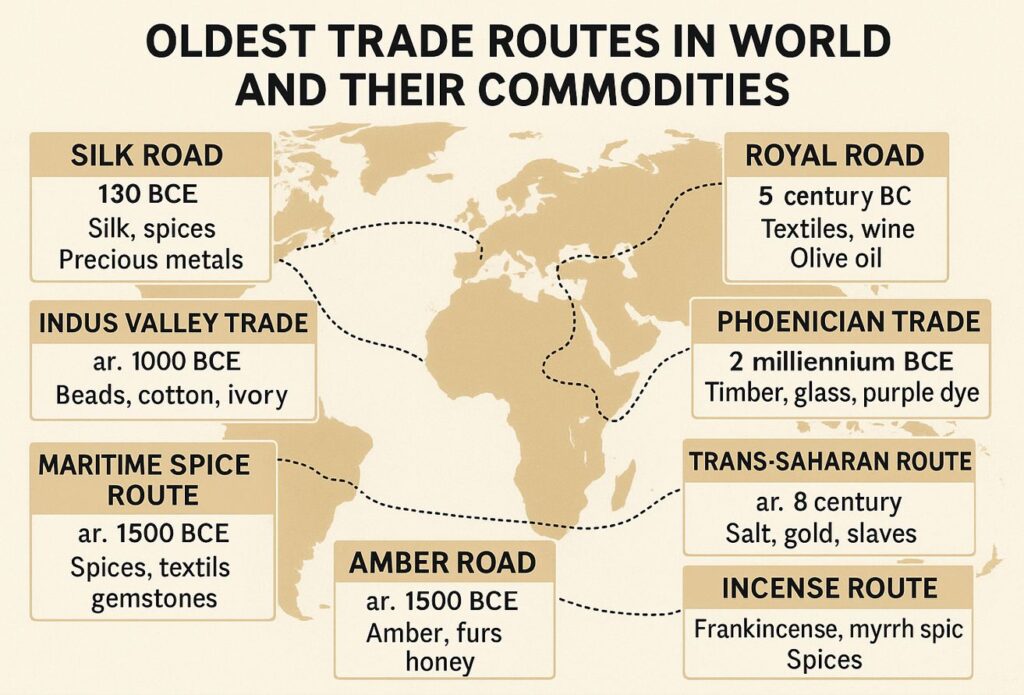
A visual infographic illustrating the oldest global trade routes—such as the Silk Road, Maritime Spice Route, Amber Road, and Trans-Saharan routes—along with the primary goods exchanged across each network.The Dawn of Commerce: Prehistoric & Bronze Age Trade Networks
1. Prehistoric Obsidian Routes (as early as 7000–6000 BCE)
Long before writing, obsidian volcanic glass prized for its razor-sharp edges was among humanity’s first major traded materials. Archaeological finds show that obsidian from Anatolia, Armenia, and the Near East traveled hundreds of miles via early barter systems.
Key commodities:
- Obsidian tools and blades
- Bone tools
- Early pigments and natural dyes
These exchanges formed the earliest long-distance networks, proving that trade existed long before formal states or organized merchants.
2. Indus–Mesopotamia Trade Network (3300–1900 BCE)
The Indus Valley Civilization maintained extensive trade with Mesopotamia through both land and maritime routes.
Exports from the Indus region included:
- Lapis lazuli
- Carnelian beads
- Cotton textiles
- Timber
- Precious metals
Imports to the Indus region included:
- Wool
- Silver
- Tin
- Grain
Clay tablets mentioning “Meluhha” likely the Indus region confirm a thriving early economy across the Arabian Sea.
Land-Based Ancient Trade Routes That Transformed Civilizations
3. The Silk Road (officially active from ~130 BCE, but paths existed earlier)
Perhaps the most iconic trade route in history, the Silk Road was not a single road but a vast network linking China to Central Asia, Persia, the Middle East, and the Mediterranean.
Major commodities:
- Silk (the most prized luxury good of antiquity)
- Spices
- Paper
- Jade
- Horses
- Glassware
- Precious metals
More than commerce, the Silk Road facilitated the spread of Buddhism, Islam, technologies such as papermaking, and countless cultural exchanges that shaped Eurasian history.
4. The Royal Road of Persia (500s BCE)
Built under King Darius I, the Royal Road connected Susa to Sardis, dramatically improving communication and trade across the Persian Empire.
Key goods traded:
- Textiles
- Metals
- Ceramics
- Luxury items for Persian elites
Its efficient design complete with rest stations became a model for future empires.
5. The Amber Road (circa 3000 BCE onward)
Amber from the Baltic region was among ancient Europe’s most coveted commodities. It traveled southward to Rome, Greece, and Egypt.
Main traded goods:
- Baltic amber
- Furs
- Salt
- Metals (iron, bronze)
Amber’s importance was so great that it appeared in Mycenaean tombs, Egyptian jewelry, and Roman luxury markets.
6. Trans-Saharan Trade Routes (from ~1000 BCE, flourishing from 700–1600 CE)
Traversing one of the harshest environments on Earth, camel caravans connected West Africa to North Africa and the Mediterranean.
Core commodities:
- Gold (West Africa’s most valuable resource)
- Salt (vital for food preservation)
- Ivory
- Kola nuts
- Slaves
- Textiles
Cities like Timbuktu and Gao became intellectual and commercial hubs as Islamic influence spread.
The Great Maritime Trade Routes of the Ancient World
7. Maritime Spice Route (as early as 2000 BCE)
Sailing across the Indian Ocean connected Southeast Asia, India, Arabia, Africa, and later Rome and China. Monsoon winds allowed predictable seasonal travel.
Key commodities:
- Cinnamon
- Cloves
- Nutmeg
- Pepper
- Textiles
- Ivory
- Gems
These goods were so valuable that spices were sometimes worth more than gold.
8. The Phoenician Maritime Network (1500–300 BCE)
Master sailors and traders, the Phoenicians connected the Mediterranean like no civilization before them.
Their most famous exports included:
- Tyrian purple dye (extremely valuable)
- Timber from Lebanon
- Glass
- Wine
- Metal goods
They founded Carthage and influenced Greek and Roman maritime traditions.
9. The Incense Route (1000 BCE–200 CE)
Stretching from southern Arabia into the Levant and Mediterranean, this route supplied empires with aromatic resins valued for religious and medicinal use.
Key commodities:
- Frankincense
- Myrrh
- Spices
- Precious stones
These goods were essential for temples, burial rituals, and royal ceremonies.
10. Red Sea & East African Coastal Trade
The Swahili Coast connected Africa to Arabia, India, and China.
Major exports:
- Gold
- Ivory
- Tortoiseshell
- Spices
- Mangrove wood
This network contributed heavily to cultural blending and the rise of Swahili city-states.
The Commodities That Powered Ancient Economies
Across all routes, several high-value goods consistently shaped trade patterns:
Luxury items and high-value commodities
- Silk
- Spices
- Incense and resins
- Perfumes
- Dyes (especially Tyrian purple)
- Ivory
- Gold and silver
Raw materials & metals
- Copper
- Tin
- Bronze
- Iron
- Timber
Everyday goods
- Salt
- Textiles
- Grain
- Ceramics
- Tools
These commodities determined the power, wealth, and diplomatic relationships of ancient empires.
Cultural, Economic, and Technological Impacts of Early Trade
The oldest trade routes were more than economic pathways they were engines of human development.
1. Cultural diffusion
Religions such as Buddhism, Christianity, and Islam spread via merchants.
2. Technological exchange
Papermaking, metallurgy, coinage, navigation tools, and mathematics transferred across continents.
3. Urban and imperial growth
Cities like Samarkand, Babylon, Alexandria, and Carthage rose to prominence through trade.
4. Early globalization
The movement of goods, people, and ideas connected distant societies long before the modern world.
Which Was the Oldest Trade Route?
While some networks like the Silk Road became more famous, the oldest known long-distance trade route dates back to prehistoric obsidian exchanges around 7000 BCE. These early exchanges laid the groundwork for the massive trade systems that followed.
The oldest trade routes in the world were not just roads—they were lifelines that shaped civilizations. They linked continents, nurtured empires, spread ideas, and created the economic and cultural foundations of the modern world. Understanding these ancient networks gives us insight into how deeply connected human societies have always been.
From obsidian traders to Silk Road caravans, from Phoenician sailors to African gold merchants, the ancient world was far more interconnected than most imagine. These early routes remain some of the greatest achievements in human history—testament to our enduring desire to explore, exchange, and connect.
FAQ’s:
1. What is the oldest known trade route in the world?
The oldest long-distance trade routes date back to prehistoric times, long before organized states or writing systems. Archaeological evidence shows that obsidian routes used to exchange volcanic glass for tools—were active as early as 7000–6000 BCE. These early pathways formed the foundation for all later trade networks, including the Silk Road.
2. Which commodities were most valuable in ancient trade?
Value varied by region, scarcity, and cultural importance, but some of the most prized ancient goods included:
- Silk
- Spices (pepper, cinnamon, cloves, nutmeg)
- Frankincense and myrrh
- Precious metals (gold, silver)
- Ivory
- Amber
- Dyes (especially Tyrian purple)
- Gemstones and beads
These items were typically lightweight, durable, and highly valued perfect for long-distance commerce.
3. How did the Silk Road differ from the Maritime Spice Route?
The Silk Road was primarily an overland route, stretching thousands of kilometers from China through Central Asia to the Mediterranean. Caravans moved through deserts, mountains, and oasis towns.
The Maritime Spice Route, by contrast, relied on sea voyages across the Indian Ocean using the predictable monsoon winds. It connected Southeast Asia, India, Arabia, and East Africa.
While the Silk Road moved luxury goods like silk, jade, and horses, the maritime route specialized in bulk spices, textiles, and tropical products.
4. Why were spices so important in early trade?
Spices were incredibly valuable because they were:
- Rare outside their regions of origin
- Essential for food preservation
- Used in medicine, rituals, and perfumes
- Considered luxury items by elites
Some spices, like cloves and nutmeg, only grew on remote Indonesian islands creating high demand and astronomical prices in the Middle East and Europe.
5. Which civilizations were connected by the earliest trade networks?
Ancient trade routes connected a surprising number of early cultures, including:
- Indus Valley Civilization
- Mesopotamia
- Ancient Egypt
- Persia
- China (Han Dynasty and earlier states)
- Phoenicians
- Greeks and Romans
- Kingdoms of Arabia
- Nubia and the early African kingdoms
- Civilizations of Southeast Asia
These connections formed the earliest examples of globalization.
6. How did ancient merchants transport goods over long distances?
Transportation methods depended on geography:
- Camels were essential across deserts (Trans-Saharan, Arabian routes).
- Horses and donkeys pulled caravans across the Silk Road and near Eastern routes.
- Ships—from Phoenician galleys to Indian Ocean dhows—carried heavy goods over sea.
- River transport was used in Egypt, Mesopotamia, and China to move bulk commodities.
Innovations like saddles, pack animals, and advanced navigation tools made long-distance trade possible.
7. What role did geography play in shaping early trade routes?
Geography dictated where trade could happen.
- Mountains created natural corridors or barriers.
- Deserts forced merchants to rely on oases and caravan routes.
- Rivers and seas made maritime trade more efficient.
- Monsoon winds enabled predictable Indian Ocean sailing.
- Resource locations (amber in the Baltic, gold in West Africa) determined commodity flows.
Trade routes evolved around these physical realities.
8. Which trade route had the biggest cultural influence?
While many routes were significant, the Silk Road had the greatest global cultural impact. It facilitated:
- The spread of Buddhism from India to East Asia
- Exchange of technologies like papermaking and silk production
- Artistic and architectural blending across Eurasia
- Major scientific, medical, and mathematical exchanges
- Diplomatic and political alliances
Its influence on global history is unmatched.
9. How did the Trans-Saharan trade route operate?
The Trans-Saharan routes relied on caravans of hundreds or thousands of camels traveling from West Africa to North Africa.
Key features:
- Salt was carried from the Sahara to West Africa.
- Gold, ivory, and kola nuts moved north.
- Trade hubs like Timbuktu, Gao, and Agadez flourished as commercial centers.
- The spread of Islam transformed the region’s culture and scholarship.
Despite harsh conditions, these routes thrived for over a thousand years.
10. What caused the decline of many ancient trade systems?
Several factors contributed to their decline:
- Political instability and wars
- Collapse of empires that maintained road security
- New maritime technologies replacing land routes
- Natural disasters and climate shifts
- Changing economic demands
- Rise of new powers controlling alternative routes
For example, the rise of European maritime trade in the 1500s greatly reduced Silk Road traffic.
11. Were land or sea routes more important in ancient times?
Both were essential, but for different reasons:
- Land routes like the Silk Road moved high-value luxury goods.
- Sea routes like the Spice Route handled large quantities and cheaper bulk items more efficiently.
Over time, maritime trade became more dominant because it was cheaper, faster, and able to move more goods at once.
12. How do archaeologists discover evidence of ancient trade?
Archaeologists identify trade links through:
- Tracing material origins (e.g., chemical analysis of obsidian)
- Examining burial goods containing foreign materials
- Studying shipwrecks and ancient ports
- Decoding inscriptions and trade records
- Identifying artifacts far from their production regions
- Unearthing caravanserais, warehouses, and marketplaces
These discoveries help reconstruct trade patterns across thousands of years.
13. What products were traded or transported along this “oldest trade route”?
The phrase “oldest trade route” is most commonly used to refer to the Silk Road, one of the earliest and longest-lasting trade networks connecting Asia, the Middle East, Africa, and Europe. Along this route, a wide range of goods were traded and transported, not just silk.
Main products traded along the Silk Road
Luxury goods
- Silk (from China, the most famous export)
- Spices such as cinnamon, ginger, and pepper
- Precious stones (jade, lapis lazuli)
- Gold and silver
- Ivory
Textiles and crafted goods
- Cotton and wool fabrics
- Carpets and tapestries
- Glassware and jewellery
- Porcelain and ceramics
Agricultural and food products
- Tea
- Rice and grains
- Dried fruits and nuts
Animals and animal products
- Horses (especially from Central Asia)
- Furs and hides
- Camels and livestock
Ideas and knowledge (non-physical but crucial trade)
- Religions such as Buddhism, Islam, and Christianity
- Scientific knowledge, mathematics, and medicine
- Technologies like papermaking, printing, and gunpowder
If you were referring instead to another ancient route, such as the Incense Route or Amber Road, tell me which one and I’ll break down the specific goods traded there.
Sources referred:
- https://en.unesco.org/silkroad
- https://www.worldhistory.org/article/1542/the-maritime-spice-roads/
- https://www.worldhistory.org/Amber_Road/
- https://www.cambridge.org/core/topics/ancient-history/ancient-economy-and-trade
- https://www.khanacademy.org/humanities/world-history