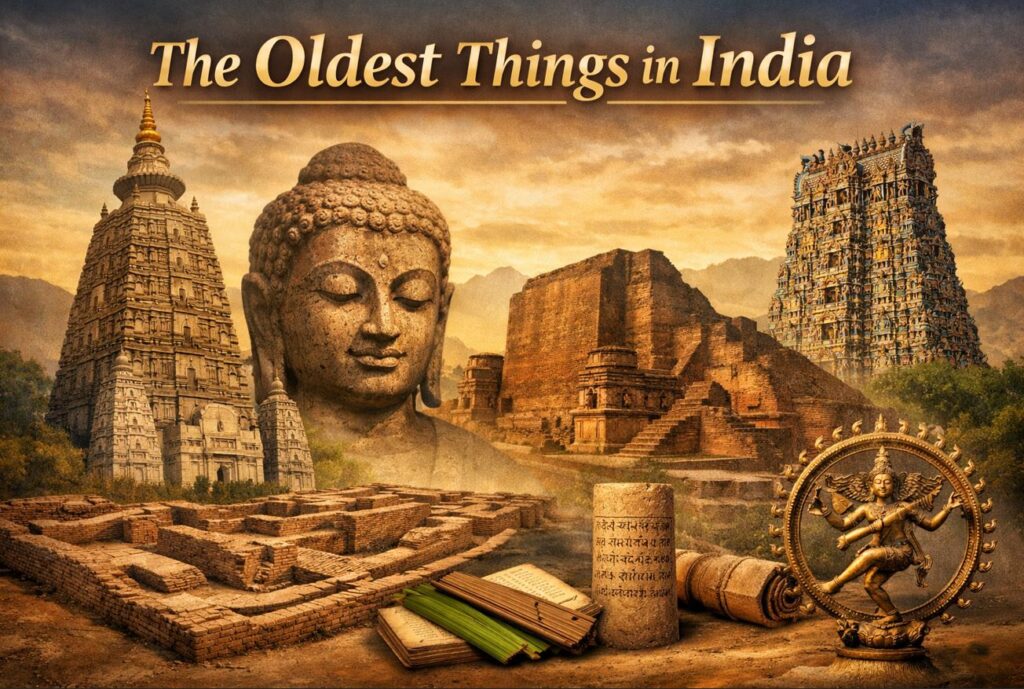
India is home to some of the world’s oldest cities, temples, universities and written records, dating back over 4,500 years, with many still in continuous use today. These include ancient cities like Varanasi, universities such as Takshashila and Nalanda, religious sites like Mundeshwari Temple and historic texts such as the Rigveda and Ashokan Edicts.
India’s uniqueness lies not just in antiquity but in unbroken continuity.
Why India’s Ancient History Is Different
Most ancient civilizations exist only in ruins. India, however, preserves living cities, functioning temples, active pilgrimage routes and studied texts that have survived invasions, empires and millennia of change.
This article presents the oldest verifiable things in India, organized by:
- Cities
- Temples & religious sites
- Universities & education systems
- Written records & manuscripts
Each section includes dates, evidence type and scholarly consensus not mythology.
🗺️ Master Timeline: Oldest Things in India (Quick Reference)
| Period | Category | Entity | Approx. Date |
| Indus Valley Era | Civilization | Harappa, Dholavira | c. 2600 BCE |
| Early Vedic Period | Text | Rigveda | c. 1500–1200 BCE |
| Pre-Mauryan | University | Takshashila | c. 600 BCE |
| Mauryan Era | Records | Ashokan Edicts | c. 250 BCE |
| Classical India | Temple | Mundeshwari Devi | c. 2nd–3rd CE |
| Gupta Period | University | Nalanda | c. 5th CE |
| Continuous Era | City | Varanasi | 3000+ years |
1. Oldest Cities in India (Continuously Inhabited)
Varanasi is the oldest continuously inhabited city in India, with archaeological and textual evidence dating back over 3,000 years.
🏙️ Comparison Table: Oldest Cities in India
| City | Estimated Age | Evidence Type | Continuous Inhabitation |
| Varanasi | 3000+ years | Archaeology, texts | ✅ Yes |
| Madurai | 2500+ years | Sangam literature | ✅ Yes |
| Patna (Pataliputra) | 2500 years | Greek accounts, ruins | ❌ Partial |
| Harappa | 4600 years | Archaeology | ❌ No |
| Dholavira | 4500 years | Archaeology | ❌ No |
Varanasi (Kashi / Banaras)
Varanasi is widely regarded as one of the oldest continuously inhabited cities in the world, with evidence of settlement dating back over 3,000 years. Archaeological findings, combined with references in early Sanskrit texts, indicate uninterrupted cultural and religious life (Archaeological Survey of India; Thapar).
Historian Diana L. Eck describes Varanasi as a city where “layers of history coexist with living tradition,” highlighting its rare continuity (Banaras: City of Light).
- Why it matters: Continuous religious, cultural and urban life
- Referenced in: Rigveda, Puranas, Buddhist texts
- Global significance: Among the oldest living cities in the world
Madurai
Madurai is one of the oldest continuously inhabited cities in South India, with a history extending over 2,500 years. Archaeological evidence, combined with references from Sangam literature, establishes Madurai as a major political, cultural, and religious center of ancient Tamilakam (Thapar).
The city developed around the Meenakshi Temple and functioned as the capital of the Pandya dynasty, playing a central role in early South Indian urbanization (Archaeological Survey of India).
- One of the oldest cities in South India
- Cultural capital of ancient Tamil civilization
- Strong literary continuity via Sangam texts
Patna (Ancient Pataliputra)
Patna, known in antiquity as Pataliputra, was founded around the 5th century BCE and became one of the largest cities of the ancient world. It served as the imperial capital of the Maurya and Gupta Empires, including the reign of Ashoka (Thapar).
Greek historians such as Megasthenes described Pataliputra as a grand, fortified city, and archaeological remains support its importance as an administrative and political hub (Archaeological Survey of India).
Harappa & Dholavira (Indus Valley)
The Indus Valley Civilization, dated to around 2600 BCE, represents the earliest known urban culture in India. Excavations at Harappa and Dholavira reveal advanced town planning, drainage systems, and standardized construction methods (Archaeological Survey of India).
Dholavira is recognized as a UNESCO World Heritage Site for its outstanding preservation and importance to early urban history (UNESCO).
- Among the world’s earliest planned cities
- Advanced drainage, standardized bricks, trade systems
- Not continuously inhabited, but civilizationally foundational
2. Oldest Temples & Religious Sites in India
Mundeshwari Devi Temple in Bihar is the oldest continuously worshipped Hindu temple in India, dating back to the 2nd–3rd century CE.
🛕 Comparison Table: Oldest Religious Sites
| Site | Religion | Approx. Date | Continuous Worship |
| Mundeshwari Devi | Hinduism | 2nd–3rd CE | ✅ Yes |
| Sanchi Stupa | Buddhism | 3rd BCE | ❌ Monumental |
| Mahabodhi Temple | Buddhism | 3rd BCE | ✅ Yes |
| Ajanta Caves | Buddhism | 2nd BCE | ❌ No |
| Ellora Caves | Hindu/Buddhist/Jain | 6th CE | ❌ No |
Mundeshwari Devi Temple
The Mundeshwari Devi Temple is considered the oldest continuously worshipped Hindu temple in India, dating to approximately the 2nd – 3rd century CE, based on inscriptions and architectural analysis (Archaeological Survey of India).
- Oldest known active Hindu temple
- Octagonal structure (rare architectural form)
- Evidence: inscriptions, architectural analysis
Sanchi Stupa
Commissioned during the reign of Emperor Ashoka in the 3rd century BCE, the Sanchi Stupa is among the earliest surviving stone religious structures in India. Its historical authenticity and age are internationally verified by UNESCO.
- Commissioned by Emperor Ashoka
- One of the earliest surviving stone structures in India
- UNESCO World Heritage Site
Mahabodhi Temple (Bodh Gaya)
The Mahabodhi Temple at Bodh Gaya marks the site where Gautama Buddha attained enlightenment in the 6th century BCE. The temple complex, originally commissioned during the reign of Emperor Ashoka in the 3rd century BCE, represents one of the oldest Buddhist pilgrimage sites in continuous use (UNESCO).
Its religious continuity and historical authenticity are internationally recognized, making it one of the most important ancient religious sites in India (UNESCO).
- Site of Buddha’s enlightenment
- Pilgrimage center for over 2,000 years
Ajanta Caves
The Ajanta Caves date from approximately the 2nd century BCE to the 6th century CE and represent some of the earliest surviving examples of Buddhist rock-cut architecture in India. The caves are renowned for their murals, sculptures, and monastic complexes (Archaeological Survey of India).
Although no longer active religious sites, Ajanta’s artistic and historical significance is globally acknowledged, and the caves are protected as a UNESCO World Heritage Site.
Ellora Caves
The Ellora Caves, constructed between the 6th and 10th centuries CE, uniquely represent Hindu, Buddhist, and Jain traditions within a single complex. The site demonstrates the religious tolerance and architectural innovation of early medieval India (Archaeological Survey of India).
The Kailasa Temple at Ellora, carved from a single rock, is considered one of the most remarkable engineering achievements of ancient India (UNESCO).
3. Ancient Universities & Education Systems
Takshashila is the oldest known university-like institution in India, while Nalanda was the world’s first large residential university.
🎓 Comparison Table: Ancient Indian Universities
| Institution | Founded | Subjects | Global Students |
| Takshashila | c. 600 BCE | Medicine, Law, Philosophy | ✅ Yes |
| Nalanda | 5th CE | Logic, Math, Medicine | ✅ Yes |
| Vikramashila | 8th CE | Buddhist studies | ✅ Yes |
Takshashila (Taxila)
Takshashila, established around 600 BCE, is recognized as the earliest known center of higher learning in India. It attracted students from across Asia and offered instruction in medicine, law, philosophy, and science (Thapar).
- Predates Plato’s Academy
- Students from Greece, Persia, Central Asia
- Functioned as a hub of interdisciplinary knowledge
Nalanda University
Founded in the 5th century CE, Nalanda was the world’s first large scale residential university, hosting thousands of students and teachers. Its scale, curriculum, and global reach are documented by historical records and recognized by UNESCO.
- Library complex (Dharmaganja) housed thousands of manuscripts
- Destroyed in the 12th century, but documented extensively by travelers
- Considered the model for later global universities
Vikramashila University
Vikramashila University was established in the 8th century CE under the Pala dynasty as a major center for Buddhist learning, particularly Vajrayana studies. Along with Nalanda, it played a crucial role in the transmission of Indian knowledge to Tibet and Southeast Asia (Thapar).
Archaeological remains confirm its scale, residential structure, and organized academic system (Archaeological Survey of India).
4. Oldest Written Records & Manuscripts
The Rigveda is the oldest surviving text in India, while Ashokan Edicts are the earliest deciphered written records.
📜 Comparison Table: Ancient Indian Records
| Record | Type | Date | Medium |
| Rigveda | Religious | 1500–1200 BCE | Oral → Manuscript |
| Ashokan Edicts | Governance | 250 BCE | Stone/Pillars |
| Arthashastra | Political | c. 300 BCE | Manuscript |
| Palm leaf texts | Scientific | 1st BCE+ | Palm leaves |
Rigveda
The Rigveda is the oldest surviving text associated with Indian civilization, composed between 1500–1200 BCE. Although initially transmitted orally, its preservation system ensured exceptional textual accuracy, as noted by modern historians (Thapar).
- Preserved via oral transmission systems
- Linguistic precision unmatched globally
- One of humanity’s oldest intellectual achievements
Ashokan Edicts
The Ashokan Edicts, dated to the 3rd century BCE, are the earliest deciphered written records in India. These inscriptions, carved on rocks and pillars across the subcontinent, provide direct evidence of early governance and ethical administration (Olivelle, Ashoka: Inscriptions).
- Written in Brahmi & Kharosthi scripts
- Promote ethical governance, tolerance, welfare
- First large-scale written administration in India
Arthashastra
The Arthashastra, traditionally attributed to Kautilya (Chanakya) and dated to around the 4th century BCE, is one of the oldest known treatises on statecraft, economics, law, and administration. It provides detailed insights into governance during the Mauryan period (Thapar).
Historians consider the text a foundational source for understanding early Indian political institutions and administrative practices.
Palm-Leaf Texts
Palm-leaf manuscripts were used in India for over two millennia to preserve religious, scientific, medical, and philosophical knowledge. Texts on Ayurveda, astronomy, mathematics, grammar, and law were transmitted through this medium across generations (Archaeological Survey of India).
The survival of palm-leaf texts demonstrates India’s long tradition of written knowledge preservation prior to the widespread use of paper.
FAQs
What is the oldest civilization in India?
The Indus Valley Civilization, dating to around 2600 BCE, is the oldest proven civilization in India.
Is India older than Egypt?
Both civilizations emerged independently around the same period; neither can be definitively called older.
Which is the oldest living city in the world?
Varanasi is among the strongest contenders, with continuous habitation for over 3,000 years.
What makes India unique historically?
India combines antiquity + continuity, unlike most ancient civilizations.
Why India’s past still lives today?
India’s oldest things are not museum artifacts alone:
- Cities are still inhabited
- Temples still receive daily worship
- Texts are still studied
- Rituals still practiced
This continuity is historically rare.
What is the oldest city in India still inhabited today?
Varanasi is considered the oldest continuously inhabited city in India, with archaeological and textual evidence indicating uninterrupted settlement for over 3,000 years.
Which is older: Varanasi or Madurai?
Varanasi is generally considered older based on archaeological layers and early textual references, while Madurai’s documented history extends reliably to around 2,500 years.
Was the Indus Valley Civilization the first civilization in India?
Yes. The Indus Valley Civilization, dating to around 2600 BCE, is the earliest archaeologically proven civilization in the Indian subcontinent.
Which is the oldest Hindu temple in India?
The Mundeshwari Devi Temple in Bihar is regarded as the oldest continuously worshipped Hindu temple, dating to the 2nd–3rd century CE.
Is the Mahabodhi Temple older than Hindu temples?
Yes. The Mahabodhi Temple complex dates back to the 3rd century BCE, making it older than most surviving Hindu temple structures.
What makes the Ajanta and Ellora Caves historically important?
Ajanta preserves early Buddhist art and murals, while Ellora uniquely represents Hindu, Buddhist, and Jain traditions within one architectural complex.
Which is the oldest university in India?
Takshashila is the oldest known center of higher learning in India, while Nalanda is recognized as the first large-scale residential university.
Did ancient Indian universities attract foreign students?
Yes. Institutions like Takshashila, Nalanda, and Vikramashila attracted students from Central Asia, China, Tibet, and Southeast Asia.
What is the oldest written text in India?
The Rigveda is the oldest surviving text associated with Indian civilization, composed between approximately 1500 and 1200 BCE.
Are the Ashokan Edicts the oldest written records in India?
They are the oldest deciphered inscriptions in India and provide direct written evidence of governance from the 3rd century BCE.
Was the Arthashastra really written by Chanakya?
Most scholars attribute the Arthashastra to Kautilya (Chanakya), though it likely incorporates material compiled over time.
What is the significance of palm leaf manuscripts?
Palm-leaf manuscripts were the primary medium for preserving knowledge in India for over 2,000 years, including science, medicine, and philosophy.
How do historians verify the age of ancient Indian sites?
Historians use archaeological excavation, carbon dating, inscriptions, architectural analysis, and cross-textual references.
Why does India have so many ancient structures still standing?
India’s climate, durable construction methods, continuous cultural use, and sustained patronage helped preserve ancient sites.
Is India older than Egypt or Mesopotamia?
India, Egypt, and Mesopotamia developed independently around similar periods; no civilization can be conclusively labeled the oldest.
What makes India a ‘living civilization’?
India’s cities, temples, texts, and traditions continue in active use, unlike many ancient civilizations that survive only in ruins.
Are ancient Indian texts still studied today?
Yes. Texts such as the Vedas, Arthashastra, and classical scientific works continue to be studied in academic and religious contexts.
Which ancient Indian site has UNESCO recognition?
Several, including Dholavira, Sanchi Stupa, Ajanta Caves, Ellora Caves, and the Mahabodhi Temple.
Did ancient India influence other civilizations?
Yes. Indian education, religion, mathematics, medicine, and philosophy influenced Asia, the Middle East, and parts of Europe.
Why is continuity important when calling something ‘oldest’?
Continuity distinguishes living traditions from abandoned ruins, making historical claims more meaningful and verifiable.
India preserves some of the oldest surviving foundations of human civilization, from cities like Varanasi to universities like Nalanda and texts like the Rigveda. What makes India exceptional is not just its age—but its unbroken cultural transmission across millennia.