India holds one of the longest and richest records of human history in the world. Archaeological evidence shows that humans lived on the Indian subcontinent over a million years ago, making it a crucial region for understanding early human evolution, migration, and cultural development.
Long before the Indus Valley Civilization built planned cities, prehistoric humans survived as hunter-gatherers, crafted stone tools, painted cave walls, and gradually transitioned to agriculture. This article provides a comprehensive, chronological, and academically grounded overview of the oldest archaeological sites in India, explaining not just where they are, but why they matter.
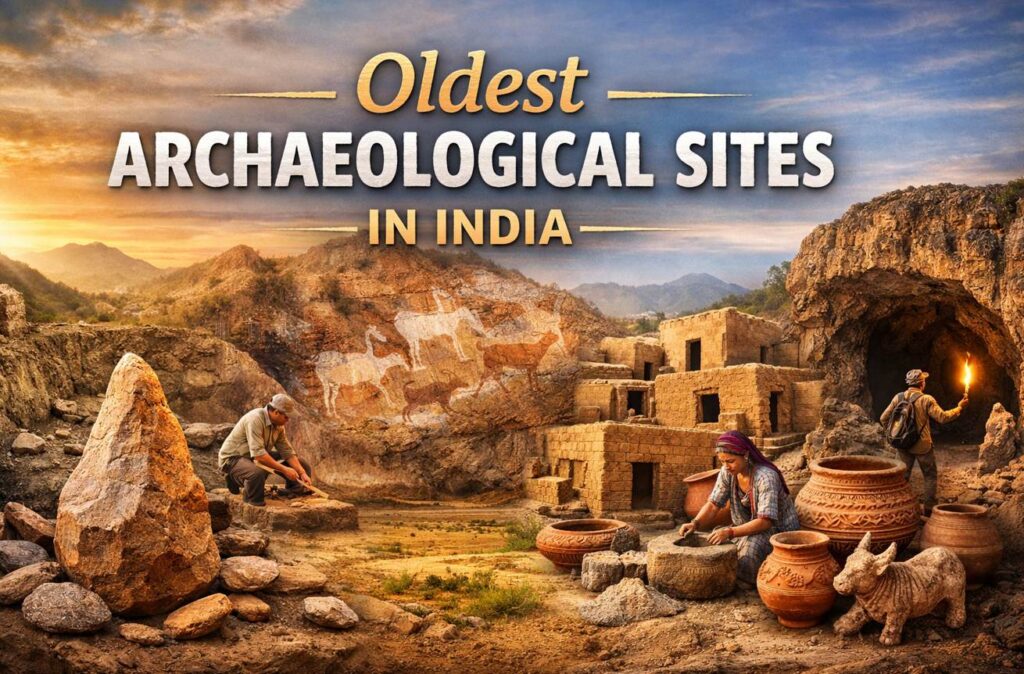
Understanding Archaeology and Prehistoric India
What Is an Archaeological Site?
An archaeological site is a location where physical remains of past human activity such as tools, dwellings, bones, art, or plant remains are preserved in layers of soil or rock. These remains allow archaeologists to reconstruct how humans lived thousands or even millions of years ago.
What Is Prehistoric India?
Prehistoric India refers to the period before written records, divided into:
- Paleolithic Age (Old Stone Age)
- Mesolithic Age (Middle Stone Age)
- Neolithic Age (New Stone Age)
- Chalcolithic Age (Stone + Copper)
Most of India’s oldest archaeological sites belong to the Paleolithic and Neolithic periods, when humans depended on stone tools and gradually adopted farming.
Timeline of Early Human Activity in India
| Period | Approximate Date | Key Features |
| Lower Paleolithic | 1.5 million – 300,000 years ago | Hand axes, hunter-gatherers |
| Middle Paleolithic | 300,000 – 40,000 years ago | Improved tools, hunting |
| Upper Paleolithic | 40,000 – 10,000 years ago | Cave use, symbolic behavior |
| Mesolithic | 10,000 – 4,000 BCE | Microliths, fishing |
| Neolithic | 7,000 – 3,000 BCE | Agriculture, pottery |
Oldest Archaeological Sites in India
1. Attirampakkam (Tamil Nadu)
Estimated Age: ~1.5 million years
Period: Lower Paleolithic
Attirampakkam is currently regarded as the oldest known archaeological site in India. Excavations have uncovered Acheulean stone tools, including hand axes, cleavers, and flakes, buried deep within ancient sediment layers.
Why Attirampakkam Is Historically Revolutionary
- Confirms very early human presence in South Asia
- Suggests early humans migrated to India much earlier than previously believed
- Demonstrates technological sophistication comparable to African sites
Scientific Importance
Advanced dating techniques, including cosmogenic nuclide dating, were used to establish the age of tools, making Attirampakkam globally significant in prehistoric studies.
2. Hunsgi Baichbal Valley (Karnataka)
Estimated Age: ~1.2 million years
Period: Lower Paleolithic
The Hunsgi Baichbal Valley is one of the largest Paleolithic landscapes in India, containing hundreds of tool-bearing localities.
Key Findings
- Acheulean hand axes
- Choppers and scrapers
- Evidence of repeated seasonal occupation
Why It Matters
This site shows how early humans:
- Chose river valleys for survival
- Reused landscapes over thousands of years
- Adapted tools to local raw materials
3. Bori (Maharashtra)
Estimated Age: ~670,000 years
Period: Lower Paleolithic
Bori gained importance due to its association with volcanic ash layers, allowing precise geological dating.
Significance
- Provides reliable chronological evidence
- Confirms Paleolithic habitation in western India
- Supports pan-Indian distribution of early humans
4. Bhimbetka Rock Shelters (Madhya Pradesh)
Estimated Age: Over 100,000 years (continuous habitation)
Status: UNESCO World Heritage Site
Bhimbetka is among the most extraordinary prehistoric sites in the world due to its uninterrupted record of human occupation.
Cave Paintings and Cultural Expression
The rock shelters contain paintings depicting:
- Hunting scenes
- Animal figures
- Rituals and dances
These artworks reflect early symbolic thinking, social life, and spiritual beliefs.
Why Bhimbetka Is Unique
- Covers Paleolithic, Mesolithic, and historical periods
- Combines archaeology with prehistoric art
- Demonstrates cultural continuity
5. Kurnool Caves (Andhra Pradesh)
Estimated Age: ~40,000 years
Period: Upper Paleolithic
The Kurnool cave complex has yielded:
- Bone tools
- Microlithic stone tools
- Evidence of cave-based living
Importance
- Suggests presence of early modern humans
- Shows advanced hunting strategies
- Indicates seasonal movement patterns
6. Adamgarh Hills (Madhya Pradesh)
Estimated Age: ~30,000–10,000 BCE
Period: Mesolithic
Adamgarh is an important Mesolithic site, showing the transition from hunting-gathering to semi-settled life.
Findings
- Microlithic tools
- Early domestication evidence
- Animal remains
7. Mehrgarh (Ancient Indian Subcontinent)
Estimated Age: ~7000 BCE
Period: Neolithic
Mehrgarh represents a turning point in human history the shift from food gathering to food production.
Why Mehrgarh Is Crucial
- Earliest evidence of agriculture in South Asia
- Domestication of cattle, sheep, and goats
- Pottery, beads, and burial customs
- Direct cultural ancestor of the Indus Valley Civilization
8. Didwana / Bargaon (Rajasthan)
Estimated Age: ~6000 BCE
Period: Neolithic / Chalcolithic
Located in Rajasthan, Didwana and nearby Bargaon provide evidence of early farming communities in western India. Archaeologists have found:
- Pottery fragments with decorative motifs
- Early domestic cattle and goat remains
- Tools for grain grinding
Significance: This site shows that agricultural practices in India were geographically widespread, not limited to Mehrgarh, marking an important stage in the Neolithic expansion.
9. Chirand (Bihar)
Estimated Age: ~2500 BCE
Period: Neolithic to Early Chalcolithic
Chirand, located along the Ganges, was a floodplain settlement that demonstrates the transition from hunting-gathering to farming in eastern India.
Key Discoveries:
- Mud-brick dwellings
- Terracotta figurines
- Early rice cultivation evidence
Why It Matters: Chirand connects pre-Harappan agricultural practices in eastern India to the larger subcontinental development of civilization.
10. Koldihwa and Mahagara (Uttar Pradesh)
Estimated Age: ~7000–6000 BCE
Period: Neolithic
Located along the Son River, these sites are among the earliest rice cultivating settlements in India. Excavations revealed:
- Circular mud houses
- Rice and millet residues
- Stone axes and grinding tools
Importance: These sites highlight the emergence of systematic agriculture in northern India, indicating regional diversity in prehistoric subsistence strategies.
List of 10 Oldest Archaeological Sites in India
| No | Site | Location | Age / Period | Key Highlights |
| 1 | Attirampakkam | Tamil Nadu | 1.5 million years | Acheulean stone tools |
| 2 | Hunsgi–Baichbal Valley | Karnataka | 1.2 million years | Large Paleolithic landscape |
| 3 | Bori | Maharashtra | 670,000 years | Early hand axes |
| 4 | Bhimbetka | Madhya Pradesh | 100,000+ years | Rock art, continuous habitation |
| 5 | Kurnool Caves | Andhra Pradesh | 40,000 years | Microliths, cave occupation |
| 6 | Adamgarh Hills | Madhya Pradesh | 30,000–10,000 BCE | Mesolithic tools |
| 7 | Mehrgarh | Balochistan / Pakistan | 7000 BCE | Early agriculture, domestication |
| 8 | Didwana / Bargaon | Rajasthan | 6000 BCE | Early farming, pottery |
| 9 | Chirand | Bihar | 2500 BCE | Early rice cultivation, mud-brick houses |
| 10 | Koldihwa & Mahagara | Uttar Pradesh | 7000–6000 BCE | Early rice cultivation, mud houses |
How Archaeologists Determine the Age of Sites
Scientific Dating Methods
- Radiocarbon dating
- Stratigraphic analysis
- Volcanic ash correlation
- Tool typology
These methods ensure that prehistoric timelines are scientifically validated
Difference Between Prehistoric Sites and Indus Valley Civilization
| Feature | Prehistoric Sites | Indus Valley |
| Economy | Hunting / early farming | Urban trade |
| Tools | Stone & bone | Bronze |
| Settlements | Temporary shelters | Planned cities |
| Writing | None | Script present |
Role of the Archaeological Survey of India (ASI)
The ASI is responsible for:
- Excavation and preservation
- Publishing excavation reports
- Protecting prehistoric heritage
- Educating the public
Frequently Asked Questions (FAQs)
1. What is the oldest archaeological site in India?
Attirampakkam in Tamil Nadu is currently considered the oldest, with stone tools dating back around 1.5 million years.
2. Which sites in India are older than the Indus Valley Civilization?
Sites such as Mehrgarh (7000 BCE), Koldihwa & Mahagara (7000–6000 BCE), Didwana/Bargaon (6000 BCE), and Chirand (2500 BCE) predate the Indus Valley Civilization (3300–1300 BCE).
3. Why is Bhimbetka significant in archaeology?
Bhimbetka (Madhya Pradesh) shows continuous human habitation for over 100,000 years and contains prehistoric rock paintings, offering insights into early art, hunting practices, and social life.
4. Which site shows the earliest human tools in India?
Attirampakkam holds the earliest known stone tools in India, including hand axes and cleavers from the Lower Paleolithic period.
5. Are there Neolithic sites older than Harappa in India?
Yes. Mehrgarh, Koldihwa & Mahagara, Didwana/Bargaon, and Chirand are Neolithic sites that predate Harappa and show early agriculture and domestication.
6. What are the major archaeological periods represented by India’s oldest sites?
The oldest sites represent:
- Lower Paleolithic (1.5 million – 300,000 years ago)
- Middle Paleolithic (300,000 – 40,000 years ago)
- Mesolithic (10,000 – 4,000 BCE)
- Neolithic (7,000 – 3,000 BCE)
- Chalcolithic (3,000 – 1,500 BCE)
7. Which sites provide evidence of early agriculture in India?
Mehrgarh, Koldihwa & Mahagara, Didwana/Bargaon, and Chirand show early farming practices, including wheat, barley, and rice cultivation.
8. How do archaeologists determine the age of these sites?
Through radiocarbon dating, stratigraphy, tool typology, and volcanic ash correlation, archaeologists can establish accurate timelines for prehistoric human activity.
9. Which is the earliest site in South India?
Attirampakkam (Tamil Nadu) is the earliest site in South India, while Hunsgi–Baichbal Valley (Karnataka) also contains early Paleolithic tools.
10. Are all these sites open to tourists?
Not all sites are open for tourism. Bhimbetka is a UNESCO World Heritage site and accessible, while some sites like Attirampakkam and Hunsgi–Baichbal are primarily research sites, and visits may require ASI permission.
11. Which sites show evidence of prehistoric art?
Bhimbetka is the most famous for rock paintings. Some minor Mesolithic sites in Adamgarh Hills also show symbolic engravings.
12. Did prehistoric humans in India live in caves or open settlements?
Both. Caves (Bhimbetka, Kurnool, Adamgarh) were used as shelters, while Neolithic settlements (Mehrgarh, Koldihwa, Chirand) were open-air, mud-brick habitations.
13. Which site has evidence of the earliest rice cultivation in India?
Koldihwa & Mahagara (Uttar Pradesh) show some of the earliest rice cultivation evidence, dating back to 7000–6000 BCE.
14. Are there UNESCO World Heritage Sites among the oldest archaeological sites in India?
Yes. Bhimbetka Rock Shelters is a UNESCO World Heritage Site recognized for its prehistoric paintings and continuous habitation.
15. Why is India important for studying early human evolution?
India provides a continuous record from Lower Paleolithic to Neolithic periods, showing:
- Early stone tool use
- Human migration patterns
- Origins of agriculture and domestication
- Cultural and symbolic expression
Why India’s Oldest Sites Matter
The oldest archaeological sites in India reveal humanity’s long struggle for survival, innovation, and adaptation. These sites are not just remnants of the past—they are evidence of how early humans laid the foundation for one of the world’s great civilizations.
Understanding them deepens our appreciation of India’s role in global human history.
References:
- https://en.wikipedia.org/wiki/Bhimbetka_rock_shelters
- https://en.wikipedia.org/wiki/Gudiyam_Cave
- https://www.gktoday.in/list-of-important-prehistoric-sites-in-india-and-their-location/
- https://www.dalvoy.com/en/upsc/mains/previous-years/2025/history-paper-i/paleolithic-site-identification
- https://pride.periyaruniversity.ac.in/SLM2024/M.A%20History/Semester_1_Core_1_History%20of%20Ancient%20and%20Medivel%20India%20-%20Pre%20-%20history%20to%201206%20Common%20Era%20%28CE%29.pdf