India is home to some of the world’s most ancient surviving places of worship shrines that have stood for over 2,000 years, surviving empires, earthquakes, invasions, and the erosion of time. Many of them remain active sites of worship today, making them among the longest continuously functioning religious structures on Earth.
This comprehensive guide explores India’s oldest temples, backed by inscriptional evidence, archaeological studies, and historical context. It presents verified dates, dynastic associations, architecture styles, and cultural impact, designed for history enthusiasts, travelers, researchers, and seekers of ancient wisdom.
1. Introduction: Why “Oldest Temple” Is Hard to Define
Identifying the “oldest temple in India” is not as simple as checking a date on a plaque. Many ancient temples were destroyed and rebuilt. Some evolved from cave shrines. Others existed long before written records.
Here’s why the debate exists:
1. Many early temples were made of perishable materials
Wood, clay, and brick structures have not survived.
2. Dynasties rebuilt older shrines
A Chola or Pallava version of a temple may stand today, while the original shrine might have existed centuries earlier.
3. Dating depends on archaeological evidence
Inscriptions, carbon dating, and architectural analysis often give approximate ranges, not exact years.
4. Oral tradition predates recorded history
Many temples claim thousands of years of antiquity, but without archaeological verification.
This article focuses on temples with credible archaeological or inscriptional evidence, while acknowledging traditions respectfully.
2. How Archaeologists Date Ancient Indian Temples
Understanding dating helps evaluate claims of antiquity.
A. Inscriptions
Stone inscriptions mentioning donors, kings, or renovations are the most reliable markers.
B. Architectural sequencing
Historians identify stylistic features unique to:
- Gupta period
- Pallava period
- Chola period
- Rashtrakuta era
- Hoysala era
These help determine approximate centuries.
C. Carbon dating
Used on organic elements found near temple sites, though not always possible.
D. Literary references
Ancient texts (e.g., Puranas, Sangam literature) sometimes mention shrines.
E. Archaeological Survey of India (ASI) studies
ASI reports are the authoritative source for dating.
3. Oldest Temples in India (Dates + Evidence Levels)
| Temple Name | Location | Estimated Date | Temple Type | Evidence Used | Notes |
| Mundeshwari Devi Temple | Bihar | 1st–2nd Century CE | Structural stone | Brahmi inscriptions + ASI studies | Widely accepted as oldest functional Hindu temple. |
| Udayagiri Caves | Madhya Pradesh | 4th–5th Century CE | Rock-cut cave temples | Gupta-era inscriptions | Earliest known Hindu cave temples. |
| Dashavatara Temple, Deogarh | Uttar Pradesh | 5th Century CE (Gupta) | Structural stone | Architectural style + ASI dating | Among the earliest North Indian structural temples. |
| Mandagapattu Temple | Tamil Nadu | c. 600 CE | Structural stone | Pallava inscription (Mahendravarman I) | Inscription claims “no use of wood, metal, or brick”, first structural temple in TN. |
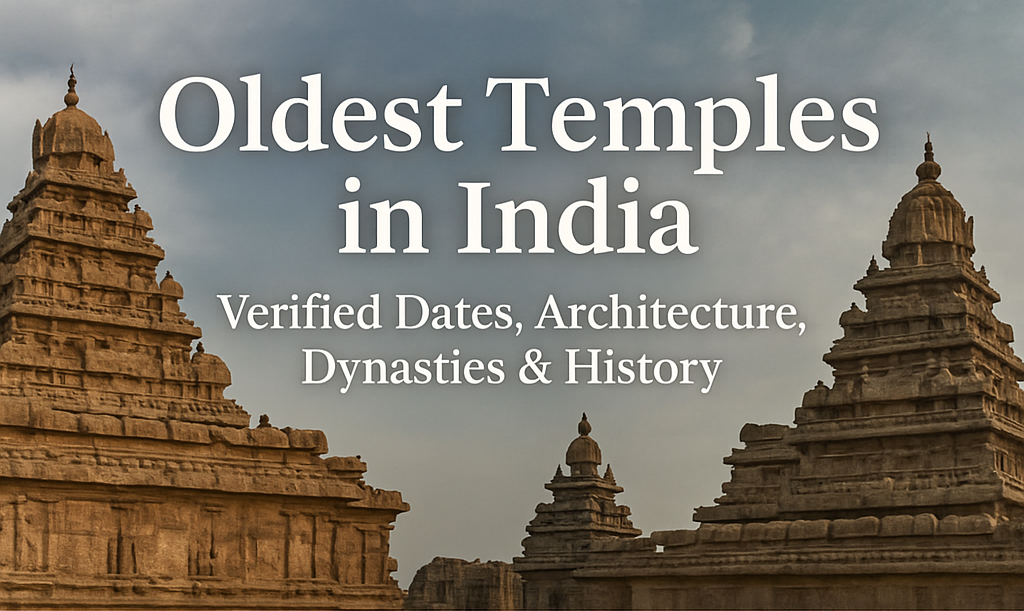
| Shore Temple, Mahabalipuram | Tamil Nadu | 700–728 CE | Structural granite | Pallava records (Rajasimha) | Oldest surviving structural temple in South India. |
| Kailasa Temple, Ellora | Maharashtra | c. 750–800 CE (Rashtrakuta) | Monolithic rock-cut | Copper plate grants, art-historical dating | Largest monolithic temple in the world. |
| Tungnath Temple | Uttarakhand | 8th–9th Century CE (tradition says older) | Himalayan stone temple | Architectural analysis | Structure is medieval; legends much older. |
| Parasurameswara Temple | Odisha | c. 650–675 CE | Structural stone | Kalinga architecture chronology | One of the earliest surviving temples in Odisha. |
| Kailasanathar Temple, Kanchipuram | Tamil Nadu | 690–728 CE | Structural stone | Pallava inscriptions | Earliest Dravidian-style structural complex. |
| Lingaraja Temple | Odisha | 11th Century CE (origins earlier) | Structural stone | Somavamsi inscriptions | Temple existed earlier but rebuilt later. |
| Brihadeeswarar Temple, Thanjavur | Tamil Nadu | 1010 CE | Structural stone | Chola inscriptions | Not oldest, but one of the most documented ancient temples. |
| Ellora Jain Temples | Maharashtra | 9th Century CE | Rock-cut | Archaeological art sequencing | Among oldest Jain temple structures. |
| Mahabodhi Temple (site) | Bihar | 3rd Century BCE (Ashoka), current 5th–6th CE | Brick/stone | Literary + archaeological evidence | Site is ancient; current temple is later. |
4. The Oldest Temples in India: Chronological List (Verified)
Below is a data backed list of India’s oldest surviving temples, across different regions and architectural styles.
1. Mundeshwari Devi Temple, Bihar (c. 1st–2nd Century CE)
Claim to fame: Possibly India’s oldest functional Hindu temple.
Located on Kaimur Hills, this octagonal temple is dedicated to Shiva and Shakti. Archaeologists discovered inscriptions referencing the 1st–2nd century CE, making it one of the earliest known functioning shrines.
Significance:
- Oldest continuous worship temple in India
- Early Nagara architectural features
- Associated with early Shaivite worship
2. Tungnath Temple, Uttarakhand (c. 8th–9th Century CE, possibly earlier)
Claim to fame: Highest Shiva temple in the world and among the oldest in the Himalayas.
Part of the Panch Kedar circuit, Tungnath is situated at 3,680 meters. Though the current structure appears medieval, traditions attribute its origin to the Pandavas (epic era). Archaeologists consider an 8th–9th century CE timeline plausible.
3. Dashavatara Temple, Deogarh, Uttar Pradesh (c. 5th Century CE – Gupta Period)
Claim to fame: One of the earliest surviving structural temples in North India.
This Vishnu temple marks a major evolution from cave temples to free standing stone temples.
Significance:
- Classic Gupta architecture
- Early example of Panchayatana layout
- Fine sculptural panels
4. Cave Temples of Udayagiri, Madhya Pradesh (c. 4th–5th Century CE)
Claim to fame: Among India’s earliest Hindu cave shrines.
These rock cut temples include the famous Varaha relief, dating back to the Gupta Emperor Chandragupta II.
5. Shore Temple, Mahabalipuram, Tamil Nadu (c. 700–728 CE – Pallava Era)
Claim to fame: Earliest structural temple in South India.
Commissioned by Narasimhavarman II (Rajasimha), the Shore Temple represents the transition from rock-cut to structural architecture.
6. Kailasa Temple, Ellora, Maharashtra (c. 8th Century CE – Rashtrakuta)
Claim to fame: The world’s largest monolithic rockcut temple.
Carved from a single rock, the Kailasa Temple is a technological and artistic marvel.
Highlights:
- Dedicated to Lord Shiva
- Vertical excavation technique
- Believed to have taken centuries of work
7. Lingaraja Temple, Odisha (c. 11th Century CE but earlier origins)
One of India’s greatest examples of Kalinga architecture, the Lingaraja temple is dedicated to Harihara, a combined form of Shiva and Vishnu.
8. Brihadeeswarar Temple, Thanjavur, Tamil Nadu (1010 CE – Chola Era)
Although not the oldest, the Brihadeeswarar Temple is among the most iconic ancient temples.
Known for:
- 80-ton monolithic granite capstone
- UNESCO World Heritage architecture
- Rajaraja Chola I’s masterpiece
5. Oldest Temples by Category
A. Oldest Functional Temple
Mundeshwari Devi Temple (Bihar) Continuous worship for nearly 2,000 years.
B. Oldest Rock-Cut Hindu Shrines
Udayagiri Caves (4th–5th century CE) Earliest verified rockcut temples for Hindu worship.
C. Oldest Structural Temple (North India)
Dashavatara Temple, Deogarh (5th century CE – Gupta)
D. Oldest Structural Temple (South India)
Shore Temple, Mahabalipuram (700–728 CE – Pallava)
E. Oldest Jain Temple
Ellora Jain Caves (9th century CE)
F. Oldest Buddhist Temple Structures
Mahabodhi Temple (original site: 3rd century BCE) (But current structure dates to the 5th–6th century CE.)
6. Oldest Temples by Indian States
Tamil Nadu (South India’s Temple Hub)
- Shore Temple (700 CE)
- Mandagapattu Temple (circa 600 CE – earliest structural stone temple inscription)
- Kailasanathar Temple (690 CE)
Tamil Nadu has the world’s largest concentration of ancient active temples.
Odisha
- Lingaraja Temple (11th century CE, earlier shrine existed)
- Parasurameswara Temple (7th century CE)
Odisha’s temples are known for intricate Kalinga architecture.
Maharashtra
- Ellora Caves (600–900 CE)
- Elephanta Caves (550–600 CE)
Some of the oldest and finest rock-cut cave temples in India.
Bihar
- Mundeshwari Temple (1st–2nd century CE)
One of the few surviving temples from early classical era.
Uttarakhand
- Tungnath (possibly pre-10th century)
- Jageshwar (7th century CE onwards)
Himalayan temples often combine mythological antiquity with medieval structures.
7. Evolution of Indian Temple Architecture
A. Cave Temples (3rd century BCE – 6th century CE)
Buddhist caves (Ajanta), Jain caves, and early Hindu caves represent the earliest form of sacred architecture.
B. Gupta Period (4th–6th century CE)
Regarded as the “Golden Age” of temple architecture.
- First structural temples
- Simple square plans
- Sculptural narratives begin to flourish
C. Early Medieval Period (7th–10th century CE)
Rise of regional styles:
- Dravidian (South India)
- Nagara (North India)
- Vesara (Deccan)
D. Chola & Pallava Era (7th–12th century CE)
Large, ornate, towering temples with elaborate carvings and grand layouts.
E. Vijayanagara & Later Dynasties (14th–17th century CE)
- Massive gopurams
- Mandapa expansions
- Temple-town complexes
8. Cultural Importance of India’s Oldest Temples
A. Continuity of Worship
Some temples have been active places of worship for centuries.
B. Architectural Milestones
They showcase India’s progress from cave temples to structural masterpieces.
C. Socio-cultural Centres
Ancient temples served as:
- Schools
- Art centers
- Dance academies
- Community hubs
D. Religious Evolution
From Vedic worship to Puranic deities, temple culture transformed India’s spiritual landscape.
9. Travel Guide: Visiting India’s Oldest Temples
Best Time to Visit
- October to March (cool and pleasant)
- Avoid monsoons for cave temples
Tips
- Respect dress codes
- Hire certified guides (ASI-approved where possible)
- Sunrise visits recommended for photography
- Check for specific ritual timings
Top Circuits
- South Indian Chola–Pallava Heritage Circuit
- Odisha Temple Architecture Trail
- Bihar–Uttar Pradesh Buddhist-Hindu circuit
- Ellora–Ajanta Cave Route
India’s oldest temples are not just monuments, they are time capsules. They reveal the evolution of architecture, religion, dynasties, and civilization itself. Whether carved out of a single rock or built stone by stone, these ancient temples continue to inspire awe with their beauty, engineering marvels, and spiritual significance.
From the 1st-century Mundeshwari Temple to the 8th-century Kailasa monolith, each structure tells a story spanning thousands of years—stories that modern India still lives, breathes, and worships through.
FAQs:
What is the oldest temple in India?
Mundeshwari Devi Temple, Bihar, is widely regarded as the oldest functional temple based on inscriptional evidence.
Which is the oldest structural temple in India?
Mandagapattu Temple (Tamil Nadu) and Dashavatara Temple (Uttar Pradesh) are among the earliest free-standing temples.
Which state has the most ancient temples?
Tamil Nadu has the highest density of ancient temples, many dating back 1,000–1,500 years.
Which is the oldest rock-cut temple?
Udayagiri Caves (Madhya Pradesh) are among the earliest rock-cut Hindu temples.
Sources to Verify Dates
- Archaeological Survey of India reports
- UNESCO World Heritage documentation
- ASI publications on Gupta, Chola, and Pallava architecture
- Indian Council of Historical Research papers
- Journals on South Asian archaeology