The oldest books in human history include the Instructions of Shuruppak (~2600 BCE), the Pyramid Texts (~2400 BCE), and the Epic of Gilgamesh (~2100 BCE). These early works were written on clay tablets and stone using cuneiform and hieroglyphs. The Diamond Sutra (868 CE) is the oldest printed book. Other foundational ancient texts include the Rigveda, I Ching, Book of the Dead, and Dead Sea Scrolls.
Continue to read this article to know more…
Long before printing presses, libraries, or even paper existed, ancient civilizations carved their stories, laws, prayers, and scientific knowledge into clay, papyrus, and parchment. These early works are the foundation of human culture, the earliest attempts to document life, belief, and the world around us.
This guide explores the oldest books ever discovered, how they were written, who created them, and why they continue to shape human civilization.
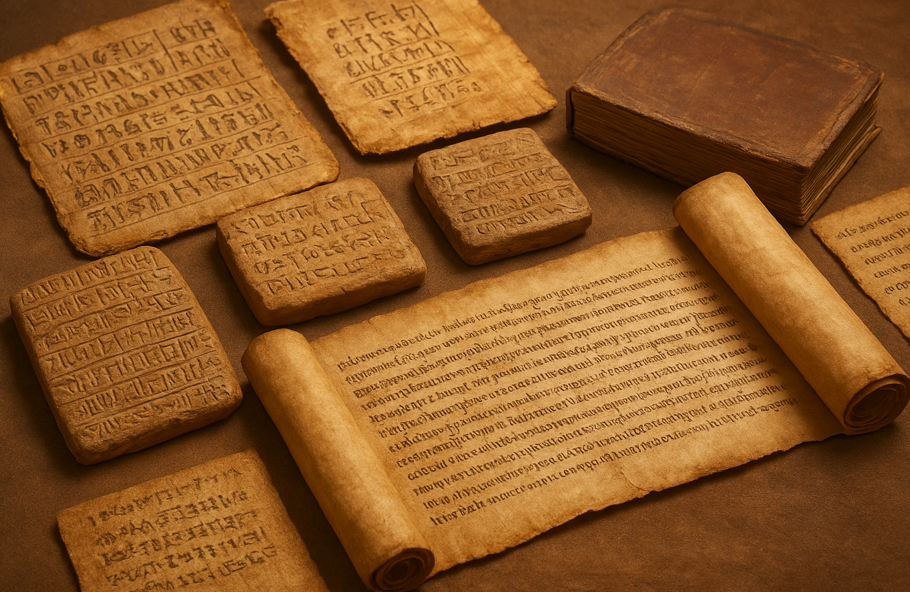
What Counts as the “Oldest Book”?
Before listing the earliest books, it’s important to clarify what “oldest” means: because the definition varies across archaeology and historiography.
1. Oldest Written Composition
The oldest story or text ever composed, regardless of whether early copies survive.
2. Oldest Surviving Manuscript
The oldest physical, original artifact still in existence today.
3. Oldest Printed Book
Books made by woodblock printing or early mechanical reproduction.
4. Oldest Book by Culture / Religion / Science
Each civilization has its own “oldest surviving” text.
Understanding these categories helps avoid confusion, because some texts were written thousands of years before the copies that survive.
The Oldest Books in Human History
Below is a chronological list of the oldest known books, based on archaeological dating and scholarly consensus. Dates are approximate and may vary across academic sources. when in doubt, verify using a trusted museum or research institution.
1. Instructions of Shuruppak (~2600–2500 BCE)
Civilization: Sumerian
Material: Clay tablets (cuneiform)
Location: Iraq
Category: Wisdom literature / advice
One of the world’s oldest surviving literary works, the Instructions of Shuruppak is a father’s advice to his son, offering moral guidance and practical wisdom. Its themes honesty, humility, avoiding bad influences are surprisingly timeless.
2. Kesh Temple Hymn (~2600 BCE)
Civilization: Sumerian
Material: Clay
Location: Tablets from Abu Salabikh
Category: Religious hymn
Often considered one of the first literature-oriented hymns, it describes the foundation of the Kesh Temple and the divine order of the world.
3. Pyramid Texts (~2400–2300 BCE)
Civilization: Ancient Egyptian
Material: Carved stone (inside pyramids)
Category: Religious funerary texts
The oldest known large religious corpus, inscribed inside the pyramids of Saqqara. These texts later evolved into the Coffin Texts and Book of the Dead.
4. Epic of Gilgamesh (~2100–1200 BCE)
Civilization: Sumerian / Akkadian
Material: Clay tablets
Location: Library of Ashurbanipal
Category: Epic literature
Often called the world’s first great story, Gilgamesh narrates a king’s journey with themes of friendship, mortality, and the search for eternal life. Parts of the epic predate Homer by over 1000 years.
5. The Rigveda (~1500–1200 BCE)
Civilization: Vedic (Indian Subcontinent)
Material: Oral composition later written on birch bark and palm leaves
Category: Religious scripture
One of humanity’s oldest and most important religious texts. Though orally preserved for centuries, the Rigveda’s oldest manuscripts date to around 1200 BCE.
6. The Book of the Dead (~1550 BCE)
Civilization: Egyptian
Material: Papyrus
Category: Funerary scripture
Not a single “book,” but a collection of spells intended to help the deceased navigate the afterlife. The most famous versions come from Thebes.
7. The I Ching (Book of Changes) (~1000 BCE)
Civilization: Chinese
Material: Bamboo slips → later paper
Category: Divination / philosophy
A foundational Chinese philosophical text based on binary hexagrams, regarded by some scholars as one of the earliest examples of binary logic.
8. The Torah / Hebrew Bible Fragments (~700–200 BCE)
Civilization: Hebrew / Israelite
Material: Parchment
Discovery Sites: Qumran, various caves
Category: Religious scripture
Although the compositions are older, the oldest physical fragments include early Torah scroll sections and the Dead Sea Scrolls.
9. The Dead Sea Scrolls (~200 BCE – 70 CE)
Civilization: Hebrew / Judaean
Material: Parchment & papyrus
Location: Qumran Caves
Category: Religious & historical manuscripts
One of the most important archaeological discoveries of the 20th century.
10. Tao Te Ching (~500–400 BCE)
Civilization: Chinese
Attributed Author: Laozi
Material: Bamboo, silk, paper
Category: Philosophy
One of the foundational texts of Taoism. The oldest manuscripts include the Guodian bamboo slips.
11. Diamond Sutra (868 CE) — Oldest Printed Book
Civilization: Chinese
Material: Woodblock printed scroll
Location: Dunhuang Caves
Category: Buddhist scripture
The oldest known printed book with a complete date. This represents a critical shift from handwritten manuscripts to mass-produced texts.
Oldest Scientific & Medical Texts
Ebers Papyrus (~1550 BCE)
A detailed Egyptian medical treatise covering surgeries, herbal remedies, and diagnoses.
Kahun Gynecological Papyrus (~1800 BCE)
The oldest medical document focusing on women’s health.
How Were Ancient Books Written and Preserved?
1. Clay Tablets
- Used by Sumerians, Babylonians, Assyrians
- Incredibly durable – preserved by baking in accidental fires (e.g., Library of Ashurbanipal)
2. Papyrus Scrolls
- Used by Egyptians and Mediterranean cultures
- Fragile – survived only in dry deserts
3. Parchment & Vellum
- Used for Hebrew texts and medieval manuscripts
- More durable than papyrus
4. Woodblock Printing
- First used in China
- Created the world’s first printed books (e.g., Diamond Sutra)
Why These Books Matter Today
They reveal humanity’s earliest beliefs
Religion, myth, and morality appear in almost every early text.
They show the origins of literature
From epic storytelling to poetic hymns.
They preserve scientific knowledge
Medical, astronomical, and mathematical systems existed long before modern science.
They document ancient civilizations
These works allow historians to reconstruct cultures that no longer exist.
Oldest Books by Region
Mesopotamia
- Epic of Gilgamesh
- Instructions of Shuruppak
- Enuma Elish
Egypt
- Pyramid Texts
- Book of the Dead
- Ebers Papyrus
India
- Rigveda
- Upanishads
China
- I Ching
- Tao Te Ching
- Diamond Sutra
Middle East
- Torah fragments
- Dead Sea Scrolls
Frequently Asked Questions
What is the oldest book ever written?
The Instructions of Shuruppak (~2600 BCE) is one of the oldest fully surviving texts.
What is the oldest story?
The Epic of Gilgamesh is widely considered the earliest epic narrative.
What is the oldest religious text?
- Rigveda (oldest continuously used scripture)
- Pyramid Texts (oldest religious writings)
What is the oldest printed book?
The Diamond Sutra (868 CE).
What is the oldest book in human history?
The Instructions of Shuruppak (c. 2600–2500 BCE) is widely considered one of the oldest surviving books. It is a Sumerian wisdom text written on clay tablets in cuneiform and discovered in Mesopotamia.
What is the oldest known story?
The Epic of Gilgamesh (~2100 BCE) is the oldest known epic narrative. It survives on Akkadian clay tablets from the Library of Ashurbanipal in Nineveh.
What is the oldest religious text?
The Pyramid Texts (~2400 BCE) are the oldest known religious writings, inscribed on the walls of ancient Egyptian pyramids.
The Rigveda (~1500–1200 BCE) is the oldest continuously used religious scripture.
What is the oldest surviving medical text?
The Ebers Papyrus (~1550 BCE) is the oldest extensive medical book, containing 700+ prescriptions and treatments.
The Kahun Gynecological Papyrus (~1800 BCE) is the oldest known medical document focused on women’s health.
What is the oldest printed book?
The Diamond Sutra (868 CE) is the oldest complete printed book with a date. It was created using Chinese woodblock printing and found in the Dunhuang Caves.
What is the oldest book by civilization?
- Sumerian: Instructions of Shuruppak (~2600 BCE)
- Egyptian: Pyramid Texts (~2400 BCE)
- Indian: Rigveda (~1500–1200 BCE)
- Chinese: I Ching (~1000 BCE) / oldest printed: Diamond Sutra (868 CE)
- Hebrew: Dead Sea Scrolls (~200 BCE–70 CE)
- Greek: Homeric texts (oral origins ~800 BCE; earliest copies later)
What materials were the oldest books written on?
Ancient books were created on clay tablets, papyrus scrolls, parchment, bamboo slips, and early woodblock-printed paper.
How do archaeologists date ancient books?
Ancient manuscripts are dated using radiocarbon dating, stratigraphy, paleographic analysis, and contextual evidence from excavation layers.
What makes a book the “oldest”?
Scholars differentiate between:
- oldest written composition (when it was created)
- oldest surviving copy (artifact still preserved)
- oldest printed book (technology-based)
Why are the oldest books important?
They preserve humanity’s earliest beliefs, laws, stories, and scientific knowledge, offering the first written record of civilization.
References:
- https://en.wikipedia.org/wiki/Instructions_of_Shuruppak
- https://www.ancient-origins.net/artifacts-ancient-writings/instructions-shuruppak-4600-years-ago-sumerian-king-instructed-his-son-021155
- https://www.historyofinformation.com/detail.php?id=207
- https://www.cabinet.ox.ac.uk/worlds-earliest-dated-printed-book-diamond-sutra-868-ce
- https://en.wikipedia.org/wiki/History_of_printing
- https://www.ebsco.com/research-starters/history/first-book-printed