Why the Search for the Oldest Language Matter
Human language is older than civilization, older than agriculture, and older than writing. It is one of the defining traits of our species. Yet only a tiny fraction of ancient languages ever left behind physical evidence and an even smaller number survived.
This page provides the most complete, research-driven, long-form guide on the oldest languages in the world, grounded in:
- Archaeological data
- Linguistic reconstruction
- Epigraphic records
- Historical timelines
- Cultural and civilizational continuity
It covers written languages, living ancient languages, proto-languages, lost scripts, and everything in between.
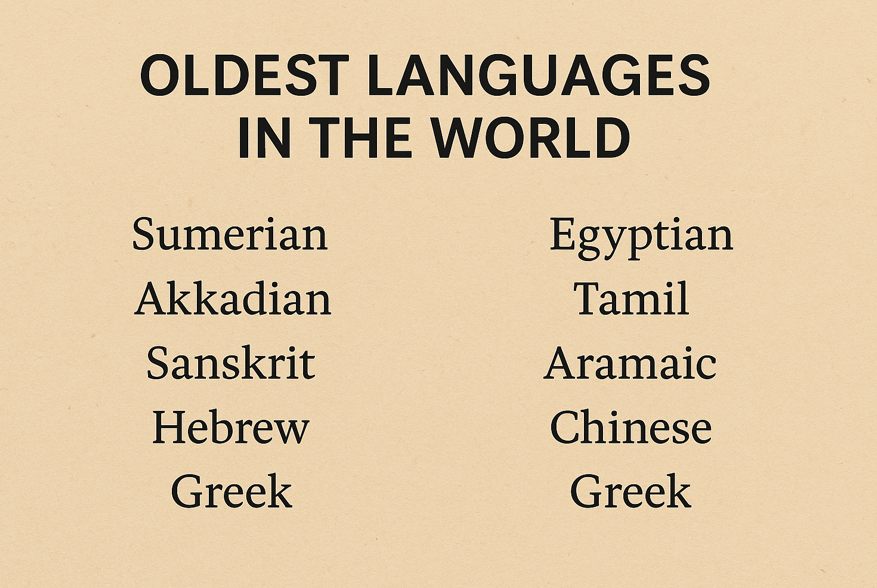
What Makes a Language “Old”?
Dating a language is not simple. Linguists evaluate languages under three distinct categories, each with different levels of evidence.
Oldest Languages by Written Evidence
These are the languages with the earliest proven inscriptions, tablets, steles, or manuscripts. Writing allows precise archaeological dating.
Written evidence answers questions such as:
- When did people begin documenting communication?
- Which civilizations invented writing?
- What linguistic features appear earliest in recorded history?
Oldest Continuously Spoken Languages
These are languages still spoken today with ancient roots and unbroken cultural continuity.
Continuity is measured by:
- Long literary history
- Cultural preservation
- Modern speakers
- Evolution rather than extinction
Oldest Reconstructed (Proto) Languages
Proto-languages have no writing, but are reconstructed using:
- Comparative grammar
- Sound change rules
- Shared vocabulary patterns
They reveal humanity’s linguistic ancestry but cannot be dated as precisely.
The Oldest Documented Languages in Human History
These languages hold the earliest undisputed written records.
Sumerian — c. 3400 BCE
Sumerian is widely accepted as the oldest written language ever discovered.
Key facts:
- Origin: Southern Mesopotamia (modern Iraq)
- Script: Cuneiform
- Status: Extinct as a spoken language; survives in liturgical texts
- Distinctive trait: A language isolate (no known relatives)
Sumerian tablets reveal administration, trade, religion, mathematics, and literary works like the Epic of Gilgamesh.
Ancient Egyptian — c. 3200 BCE
Appearing just after Sumerian, Ancient Egyptian developed an independent writing system.
Characteristics:
- Script: Hieroglyphic, Hieratic, Demotic
- Descendant: Coptic
- Longevity: Over 3,000 years
Egyptian’s graphic complexity influenced later writing traditions and monumental architecture.
Akkadian — c. 2500 BCE
Akkadian replaced Sumerian as the dominant language of Mesopotamia.
Features:
- Type: Semitic language
- Script: Adapted cuneiform
- Dialects: Assyrian, Babylonian
Akkadian diplomatic letters such as the Amarna Letters reveal international politics of the ancient Near East.
Elamite — c. 2300 BCE
Spoken in southwestern Iran, Elamite is known from royal inscriptions and administrative records.
Interesting note:
Elamite may be related to Dravidian languages, but linguistic evidence is debated.
Hittite — c. 1600 BCE
The earliest Indo-European language with a large written archive.
Importance:
- Provides clues about Proto-Indo-European (PIE)
- Uses cuneiform
- Contains early legal and mythological texts
Hittite’s decipherment revolutionized modern historical linguistics.
The Oldest Living Languages Still Spoken Today
Several ancient languages continue to thrive, evolving over millennia.
Tamil — 500 BCE or older
Tamil is one of the oldest continuously spoken languages on Earth.
Evidence:
- Tamil-Brahmi inscriptions (c. 500 BCE)
- Sangam literature (c. 300 BCE – 300 CE)
- Active, modern spoken language with 75+ million speakers
The Tamil linguistic tradition includes poetry, grammar, philosophy, and early Dravidian culture.
Hebrew — c. 1000 BCE
Hebrew transitioned from ancient inscriptions to Biblical Hebrew and was later revived in the 19th century.
Significance:
- Liturgical role in Judaism
- Successfully revived as a spoken modern language
Aramaic — c. 1100 BCE
Once the dominant lingua franca of the Near East.
Today:
Small communities still speak Neo-Aramaic dialects in the Middle East and diaspora.
Chinese — 1250 BCE (written)
Old Chinese appears in oracle bone inscriptions.
Importance:
- One of the world’s longest continuous writing traditions
- Foundation for all modern Chinese dialects
Greek — c. 1400 BCE
Greek has been spoken continuously for over 3,400 years.
Earliest evidence:
Linear B tablets from Mycenaean Greece.
Culturally Influential Ancient Languages
Some languages are not the oldest, but shaped large portions of the world.
Sanskrit — c. 1500 BCE (oral), 1200 BCE (written)
Sanskrit is foundational for:
- Hindu philosophy
- Classical Indian literature
- Indo-European linguistic reconstruction
Latin — c. 700 BCE
Latin is the ancestor of:
- Spanish
- French
- Portuguese
- Italian
- Romanian
It also shaped scientific vocabulary worldwide.
Classical Arabic — c. 600 CE
With the Qur’an as its core text, Classical Arabic transformed language, philosophy, and science across regions.
Proto-Languages and Prehistoric Linguistic Roots
These reconstructed languages represent humanity’s deepest linguistic ancestry.
Proto-Indo-European (PIE)
Ancestor of languages from Iceland to India.
Proto-Semitic
Ancestor of Hebrew, Arabic, Aramaic.
Proto-Dravidian
Root of Tamil and other Dravidian languages.
Proto-Sino-Tibetan
Gives rise to early forms of Chinese.
The Oldest Writing Systems Ever Developed
Writing systems determine our earliest verifiable linguistic evidence.
- Cuneiform — Sumer, 3400 BCE
- Hieroglyphics — Egypt, 3200 BCE
- The Phoenician Alphabet — 1050 BCE
- Ugaritic Cuneiform — 1400 BCE
These scripts influenced alphabets, literacy, administration, and early literature.
Lost, Undeciphered, and Mysterious Ancient Languages
These languages could rewrite history once deciphered.
Examples:
- Indus Script (Harappan)
- Linear A (Minoan)
- Proto-Elamite
- Rongorongo (Easter Island)
These may predate known writing but remain unreadable.
Chronological Timeline of Language Evolution
A clear, evidence-based timeline:
Before 3500 BCE
Only spoken languages.
3400–3200 BCE
Sumerian and Egyptian writing appear.
2500 BCE
Akkadian and Elamite emerge.
1500–1200 BCE
Sanskrit, Mycenaean Greek, early Chinese inscriptions.
1000–500 BCE
Growth of Hebrew, Tamil, and Latin traditions.
500 BCE–500 CE
Classical periods of Greece, India, Rome.
After 600 CE
Arabic emerges as a major linguistic-cultural force.
FAQ: The Most Searched Questions Answered
What is the oldest written language?
Sumerian.
What is the oldest living spoken language?
Tamil is among the strongest contenders.
What language did the first humans speak?
Unknown, no evidence survives.
Is Sanskrit the oldest language?
It has one of the oldest oral traditions, but its written form is younger than Sumerian.
Are Hebrew and Aramaic older than Greek?
Their earliest inscriptions are roughly similar in age, but vary regionally.
What language influenced the most others?
Latin, Sanskrit, and Classical Arabic have enormous cultural reach.
Reference links:
- https://www.britishmuseum.org/collection/object/Y_EA24
- https://www.metmuseum.org/art/collection/search#!/search?material=Elamite
- https://ctext.org/
- https://lrc.la.utexas.edu/lex
- https://www.soas.ac.uk/about/colleges-schools-and-departments/college-humanities/school-languages-cultures-and-0
- https://rmrl.in/en
- https://www.tamilvu.org/